
There is an old Camel advertisement from the early days of television where doctors complain about the stress of the night shift. I imagine overnight work at a hospital is trying, but you wouldn’t know it to look at these handsome, clean-cut men with pressed suits and easy smiles. They are relaxing on a couch, enjoying the coffee that an eager-to-please nurse has just placed in front of them.
“That’s right,” one doctor agrees with the other, “but a Camel’s always a pleasure.
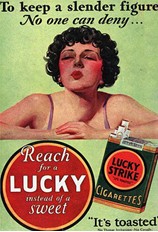
The Doctors Enjoy Camels campaign traded in the imagery of health-conscious smoking, sometimes accompanied by lists of different medical specialties that endorsed Camel products. The brand was a little behind the times; Lucky Strike began sending cartons of cigarettes to doctors in the 1920s, and Phillip Morris had adopted the medical strategy in 1937. Cigarettes were a way to fix what ailed you. Cool, calm men and attractive, curvy women smoked.
Everyone wants to be healthy, but when the companies aired these campaigns, they knew it wasn’t true. It did not take much time for the cigarette companies to link smoking and lung cancer, because lung cancer was a rare condition for most of human history. By the 1940s and 1950s there wasn’t a factual question that the tobacco companies knew their product killed people.
The companies kept lying. In 1954, consortium of tobacco makers released “A Frank Statement to Cigarette Smokers” in response to recent studies linking smoking and lung cancer. Recognizing the importance of health and claiming to care deeply about the public, the statement invoked unspecified “distinguished authorities” who disputed the connection and maintained “that there is no proof that cigarette smoking is one of the causes.”
To absolutely no reader’s surprise, this essay isn’t about cigarettes. It’s about social media. The journalist Derek Thompson has recently argued in response to a landmark verdict against Meta that social media is nothing like cigarettes. I disagree. In a few decades, we will look back on them with the same contempt for life-destroying greed and the same passive wonderment at what generations before allowed to happen.
If you’re about my age or older – I’m a middling millennial – you probably remember the age of optimism about social media. The first wave of serious healthful enthusiasm I remember for it was in 2011. People revolted in mass protests against dictatorships in Tunisia. Then Egypt. Then Syria. It looked as if North Africa and the Middle East were experiencing the sort of epochal transformation that the US and Europe underwent with the rise of liberal democracies. Excited commentators called it the Arab Spring.
Other names emerged. The Facebook Revolution. The Twitter Revolution.
Evronia Azer tries to parcel out truth and deception in these names. There’s an important sense in which these were not social media revolutions at all. Many aren’t completed revolutions (some conflicts are still ongoing). Regimes cut off internet access and forced people to mobilize and organize in offline ways, and the revolts themselves were about the material and ongoing conditions in which people lived.
Mark Zuckerburg’s early vision for Facebook was not to cause political revolutions. Fred Vogelstein Yale School of Medicine, from Facebook’s early days in 2007 through 2021, the youth suicide rate increased by 62%. That’s the aggregate number; for some groups its much worse. The suicide rate for black teens in that period increased an astonishing 144%. As with cigarettes, it didn’t take long to find the obvious associations. Suicides were correlated with social media use.
The companies knew. In 2021, the Wall Street Journal reported on internal research from Instagram, which is owned by Facebook. Instagram’s own researchers concluded the platform caused depression, body image issues, and even suicidality. In other words, Instagram is aware its product is toxic. Not only that, but it intentionally amplifies that toxicity to profit. Instagram can target advertising to people it knows are particularly vulnerable in their self image. For example, they know that teen girls tend to delete selfies when they are not feeling good about their appearance – which provides the perfect moment to serve an advertisement for weight loss or beauty products.
Instagram didn’t release that research voluntarily. The Journal obtained it as part of a large collection of internal documents its reporters published stories on showing the operations of Facebook behind the scenes. Instagram and Facebook, after all, need to keep growing their market share. Every person they can reach is a new product they can sell.
Wynn-Williams’s Careless People makes it clear that Facebook knows about its political effects on the world as well. Facebook knew that the military government in Myanmar used the platform to organize the 2017 mass rape and genocide of Rohingya Muslims. It knew that it helped destabilize American democracy and empower Donald Trump. It offered the Chinese government “special access to users’ data” and bespoke censorship tools as well, in order to help the regime maintain “safe and secure social order.””
Elon Musk’s purchase of Twitter and conversion of it into a haven for white nationalist and Trumpist sentiments is not an aberration. It’s social media working as intended, a tool to funnel control to the already powerful. Concentrating all data about everyone everywhere in the hands of a small and powerful elite who own social media platforms isn’t a tool for political emancipation. It’s a tool to end political movements.
A lung cancer death is $10,000 of profit to a tobacco maker. How much is every teenager who hangs themselves worth to Meta? What’s the value of every dissident social media helps oppressive regimes incarcerate? What don’t we know about what the social media companies do? What will come out in the next decade, or two, or five?
There are new social platforms cropping up all the time, new alternatives to twitter. Every platform is more attractive in the beginning to attract users. That’s the first phase of Cory Doctorow’s cycle of enshittification. The companies have to get you in the door so they can lock you into the product, slowly increasing the costs of shifting to a different platform. Once they’ve done that, you become part of the product and they begin to shift value from you, to their advertisers, and then to themselves. Threads might be a more pleasant experience than twitter for the moment, but its owned by the same company that turned enshittification into an art form. If you want to know the future of Threads, look at Facebook and Instagram.
That’s why I made this little neocities site. I understand the appeal of social media, the ability to connect and exchange ideas and connection with people all over the world – the promise of it is marvelous. This little corner of the internet doesn’t have any of the engagement and algorithms and web2.0 technology that allowed the platforms to enshittify as aggressively as they did, and so my hope is that some magic of the old internet will live on here.
As for the social platforms, but if you want my opinion, plug your ears to the siren songs of the remaining techno-optimists. Try to quit. Don’t smoke those things. They’ll kill ya.